
You Don’t Usually Realize You Need Boundaries Until After You’ve Said Yes
Let’s be honest for a moment.
There are days when everything already feels full, your mind, your schedule, your energy. You’ve been working, responding to messages, handling things at home, trying to stay present with your kids, and somewhere in the middle of all of that, someone asks you for something. It doesn’t sound like a lot. It actually sounds small. And almost automatically, you say yes.
And still, I told myself the same things many of us say in those moments:
I remember one day I was in the middle of work, headset on, trying to focus, while already thinking about everything waiting for me after, dinner, checking in with the kids, and honestly just wanting a quiet moment to breathe. Then I got a message asking for help. It wasn’t urgent. It wasn’t even that big. But I said yes anyway. And the moment I did, I felt it. Not as a thought, but in my body. A quiet drop in my energy. A subtle tension in my chest. Like something in me had just agreed to something I didn’t fully have the space for.
- “It’s not a big deal.”
- “I can handle it.”
- “I don’t want to make things uncomfortable.”
So I followed through. But later that day, I noticed the shift. I was more irritable than usual. Less patient. Not fully present with my kids. And it took me a moment to realize that it wasn’t what I had done that affected me. It was the fact that I didn’t listen to myself before I agreed.

The Small Moments Where It Happens
What makes this pattern difficult to catch is that it rarely shows up in big, obvious ways. It lives in the small, everyday moments that feel easy to overlook. It becomes a way of moving through your day without really pausing to check in with yourself.
For many women, it can look like:
- Saying yes to something when you are already tired
- Replying immediately when you actually need space
- Agreeing just to avoid the discomfort of saying no
- Overexplaining yourself so the other person feels okay
- Showing up for others while quietly putting yourself last
Over time, these small moments begin to accumulate. You may start to notice that you are constantly responding, adjusting, and accommodating, without ever fully asking yourself what you need in that moment. It can leave you feeling drained, disconnected, and unsure why, especially because nothing seems “big enough” to justify that feeling.
What This Feels Like at the End of the Day
For me, this usually becomes clear at the end of the day. When everything gets quiet, and I finally have a moment to sit down, I can feel the weight of everything I carried—not just physically, but emotionally. That’s often when I reach for something small to help me come back to myself. I’ll make a cup of tea , sit in a quiet space, and sometimes open my journal just to process what I’m feeling. Lighting a candle has also become one of those small signals to my body that the day is slowing down and I can finally exhale.
These aren’t big rituals. They’re simple ways to reconnect. But in those moments, I can usually trace my day back and recognize where I left myself. The moment I said yes when I meant no. The moment I ignored that internal hesitation. The moment I chose comfort over honesty.
And This Is Where Boundaries Actually Begin
Boundaries don’t begin in confrontation or perfectly worded responses. They don’t begin when you finally say no. They begin earlier than that, in a much quieter place. They begin in awareness.
They begin when you start noticing:
- The moment your body feels resistance
- The hesitation you usually ignore
- The internal “no” that gets overridden by a quick “yes”
Because the truth is, you don’t need to become a different woman to set boundaries. You need to become a woman who is willing to hear herself first. And that shift doesn’t happen all at once. It starts in these small moments, where you begin to pause, notice, and acknowledge what you feel before responding.
That is where self-respect begins.
The Quiet Patterns You Don’t Always Notice
Once you start paying attention, you begin to realize that it’s not just one moment. It’s a pattern. And not in a way that makes you feel bad about yourself, but in a way that makes things… clearer.
Because the truth is, most of us are not constantly making conscious decisions to abandon ourselves. We’re moving quickly. We’re responding. We’re trying to keep things smooth, peaceful, manageable. And in that process, we develop habits that feel normal, even when they’re costing us.
I didn’t always notice it right away either. It wasn’t until I started slowing down, usually at the end of the day, sometimes with my journal , that I began to see how often I was saying yes without even checking in with myself first. It wasn’t intentional. It was automatic.
And that’s what makes it powerful to notice.
What This Pattern Can Look Like in Real Life
It doesn’t always show up in obvious situations. Sometimes it’s quiet, subtle, almost easy to justify in the moment. But when you step back, you begin to see how consistent it is.
You might recognize yourself in some of these:
- You say yes quickly, and only later realize you didn’t actually have the capacity
- You feel the need to explain your decisions so others feel comfortable with them
- You prioritize keeping the peace, even if it creates tension within you
- You respond right away, even when you’re tired or overwhelmed
- You adjust your needs depending on who you’re around
And on the surface, these things can look like kindness. Like flexibility. Like being easy to be around.
But underneath, it can feel different.
What It Feels Like Internally
What I’ve noticed in myself, and in so many women, is that the external behavior doesn’t always match the internal experience. On the outside, everything looks fine. You’re showing up. You’re helping. You’re being present.
But internally, it can feel like:
- A quiet pressure to keep everything balanced
- A subtle anxiety about disappointing others
- A constant mental loop of “Did I do enough?”
- A sense of being stretched thin without fully understanding why
I remember moments where I would finally sit down, thinking I could relax, and instead my mind would start replaying conversations. What I said. What I could have said differently. Whether I showed up the “right way.” And instead of feeling at ease, I felt… unsettled.
That’s when I started realizing that it wasn’t just about being busy. It was about how often I was moving through my day without actually being anchored in myself.
Why It’s So Easy to Miss
The reason this pattern can go unnoticed for so long is because it’s often reinforced. People appreciate you. They rely on you. They see you as dependable, supportive, easy to talk to.
And those things are not wrong.
But when your sense of ease for others comes at the expense of your connection to yourself, it creates a quiet imbalance. One that doesn’t always show up immediately, but builds over time.
Sometimes the only signal is how you feel when everything finally gets quiet.
That moment when you reach for something to slow yourself down—your tea , a candle , a few minutes alone, and you realize how far you’ve been stretching yourself just to maintain everything around you.
And This Is Where Awareness Deepens
This is not about judging yourself or labeling these patterns as wrong. It’s about seeing them clearly enough to understand what’s actually happening beneath them.
Because once you can recognize the pattern, you create space.
Space to pause. Space to check in. Space to begin choosing differently.
And that’s where things start to shift, not all at once, but gradually. Not perfectly, but intentionally.
You begin to move from automatic responses… to aware ones.
And that is where real change begins.
What You Thought Was Kindness… Might Actually Be Costing You
This is the part that took me a minute to really sit with.
Because for a long time, I genuinely believed I was just being a good person. I was being kind. Understanding. Easygoing. The kind of woman people could rely on. And honestly… there’s nothing wrong with those qualities.
But at some point, I had to ask myself a different question.
Not “Am I being kind?” But… “At what cost?”
Because if I’m honest, a lot of what I was calling kindness didn’t always feel good in my body.
It felt like pressure. It felt like obligation. It felt like I was constantly adjusting myself to keep everything smooth.
And that’s when the shift started.
The Truth We Don’t Always Want to Admit
Sometimes what we call kindness… is actually discomfort avoidance.
Not always. But often.
It may look like:
- Saying yes so you don’t have to deal with someone’s reaction
- Explaining yourself in five different ways so you don’t feel misunderstood
- Agreeing quickly so you can move past the moment without tension
- Smiling through something you don’t actually agree with
And listen, I’ve done all of that. Still catch myself doing it sometimes.
Because let’s be real, saying no can feel awkward. Your voice might get a little shaky. Your mind starts racing. You suddenly care a lot about how your sentence is landing. And now you’re halfway into a “yes” before you even realize what’s happening.
It’s like your body is saying, “Abort mission, this feels uncomfortable,” and your mouth is like, “Absolutely, I can do that for you 😊.”
Why This Doesn’t Actually Create the Connection You Think It Does
Here’s the part that changed everything for me.
I used to think that being accommodating was what kept relationships strong. That being understanding, flexible, and available would make people value me more.
But what I started noticing was this:
- The more I overextended, the more it was expected
- The more I adjusted, the less I felt seen
- The more I gave, the more disconnected I felt from myself
And it wasn’t because people were trying to take advantage of me.
It was because I wasn’t showing them where I ended.
There were no clear lines. No real boundaries. Just a version of me that kept stretching to make things work.
What It Actually Leads To (Even If You Don’t Say It Out Loud)
When this pattern continues, it doesn’t usually explode all at once. It builds quietly.
It can start to feel like:
- You’re doing a lot, but not feeling deeply valued
- You’re present, but not fully seen
- You’re giving, but not really receiving
And then there’s that feeling… the one you don’t always say out loud.
The subtle irritation.
The quiet resentment.
The thought of, “Why am I always the one…?”
I’ve had moments where I had to literally step away, make myself a cup of tea , sit in silence, and ask myself, “Okay… what is really bothering you right now?”
And the answer was rarely the situation itself.
It was the fact that I had ignored myself again.
The Reframe That Changes Everything
So here’s the truth I had to learn—and honestly, keep reminding myself of:
Being kind does not mean being available at your own expense.
Being understanding does not mean overextending yourself.
And being a good person does not require you to abandon yourself in the process.
Real kindness, the kind that actually feels good and sustainable, includes you.

It considers your energy.
Your capacity.
Your truth.
And when you start to see it that way, something shifts.
You realize that boundaries are not you becoming difficult.
They are you becoming honest.
Why Boundaries Feel So Hard (Even When You Know You Need Them)
This is usually the part where women pause and think, “Okay… I get it. I should set boundaries.”
But then real life happens.
And suddenly, that clear understanding disappears the moment you’re in front of someone, your phone lights up, or you’re asked something directly. And instead of responding from that grounded place you felt while reading this… you feel that familiar tension again.
And if you’re honest, it’s not that you don’t know what to say.
It’s that saying it feels… uncomfortable.
For a long time, I thought I just needed the right wording.
Something soft. Something polite. Something that wouldn’t make anyone feel any type of way. I used to mentally rehearse responses like I was preparing for a presentation:
- “Okay, maybe I’ll say it like this…”
- “No, that sounds too direct…”
- “Let me add a little explanation so it feels nicer…”
Next thing you know, my “boundary” turned into a full paragraph with context, disclaimers, emotional cushioning, and a closing statement.
At that point… it wasn’t even a boundary anymore. It was a negotiation.
And usually, I would still end up doing the thing I didn’t want to do.
What’s Actually Underneath It
What I had to understand—and what most women don’t realize at first—is that this isn’t just about communication.
It’s about safety.
At some point in your life, you may have learned—without anyone sitting you down and explaining it—that:
- Saying no could create distance
- Having needs could feel like a burden
- Being easygoing kept things smooth
- Keeping the peace meant staying connected
So your system adapted.
You became someone who could read the room, adjust quickly, and avoid tension before it even started. And honestly, that probably helped you in a lot of situations. It made you reliable. It made you thoughtful. It made you someone people felt comfortable around.
But now… it’s also what makes boundaries feel so hard.
Because when you try to set one, your body doesn’t just feel “a little uncomfortable.”
It feels like you’re doing something wrong.
The Moment It Hits in Real Life
You know that moment.
Someone asks you for something. You feel the hesitation immediately. You know what you want to say. And then, almost instantly, your mind starts doing its thing:
- “What if they take this the wrong way?”
- “I don’t want them to feel bad…”
- “It’s probably easier if I just do it…”
And just like that… you override yourself.
Again.
I’ve had moments where I literally felt my body pause, like it was waiting for me to choose differently. And instead, I went with what felt familiar. Later, I’d be sitting there, maybe with my journal or just trying to unwind, and I could trace the exact moment I didn’t listen to myself.
And it wasn’t because I didn’t know better.
It was because choosing myself felt unfamiliar in that moment.
Why This Pattern Stays
The hardest part about this is that it’s often reinforced.
People appreciate you.
They rely on you.
They expect you to show up the way you always have.
So when you think about changing that dynamic, it doesn’t just feel like a small adjustment. It feels like you’re disrupting something.
And your system doesn’t love disruption.
It prefers what’s predictable. What’s known. What’s already been working—even if it’s quietly costing you.
So instead of setting the boundary, you reach for something that helps you settle afterward. Maybe you make yourself a cup of tea , light a candle , and try to decompress from a day that felt heavier than it needed to be.

But the weight didn’t come from everything you did.
It came from how many times you left yourself while doing it.
And This Is Where the Real Work Begins
Not in forcing yourself to suddenly become someone completely different.
Not in saying everything perfectly.
But in understanding that your hesitation makes sense.
You’re not weak for finding this hard.
You’re not “bad at boundaries.”
You’re simply unlearning a pattern that once helped you feel safe.
And when you start to see it that way, something softens.
You stop judging yourself.
You start observing yourself.
And that’s where real change becomes possible.
What This Pattern Is Quietly Costing You
On the surface, everything can still look like it’s working. You’re showing up, handling your responsibilities, responding to people, and keeping things moving. Nothing is visibly falling apart, and from the outside, it may even look like you have it all together. But when you slow down and really check in with yourself, there is often a different experience happening internally—one that feels heavier than it should.
I remember having days where I technically completed everything that needed to be done. Work was handled, things at home were taken care of, and everyone else seemed okay. Yet by the end of the day, I felt drained in a way that didn’t match the actual tasks I had done. It took me time to understand that the exhaustion wasn’t only coming from what I was doing, but from how often I was disconnecting from myself while doing it.
It Doesn’t Always Show Up the Way You Expect
The cost of not having boundaries is rarely loud or immediate. Instead, it builds gradually and begins to show up in ways that are easy to dismiss or overlook, especially because each moment feels small on its own.
You may begin to notice patterns like:
- Feeling tired even after a relatively normal day
- Becoming irritated by small things that would not usually affect you
- Wanting space, but not knowing how to give it to yourself
- Being physically present in conversations while feeling mentally distant
- Craving time alone, yet feeling guilty for taking it
Alongside these patterns, there can also be internal thoughts that quietly surface and then get pushed away just as quickly:
- “Why do I feel like I’m always the one doing the most?”
- “Why does this feel heavier than it should?”
And almost immediately, those thoughts are softened or dismissed:
- “Maybe I’m overthinking this.”
- “It’s not that serious.”
- “I should just be grateful.”
In that process, the signal your body is giving you is ignored, and the pattern continues.
The Emotional Cost That Builds Over Time
When this pattern repeats, it begins to affect more than just your energy. It starts to influence how you experience your relationships, your sense of self, and your overall emotional state.
You may begin to feel:
- A quiet sense of resentment that is difficult to explain
- A feeling of being unseen, even though you are constantly present
- Disconnected from what you actually want or need
- Like you are giving consistently, but not truly receiving
There have been moments where I had to sit down and ask myself honestly what I was feeling and why. In most cases, it was not because someone else had done something wrong. It was because I had continued to say yes in situations where I did not have the capacity or the desire to do so.
The Moment It Becomes Clear
For many women, this realization does not happen in the middle of the day when everything is moving quickly. It tends to show up when things slow down and there is finally space to feel what has been carried.
For me, that moment often comes in the evening. When everything is quiet, I find myself needing to decompress and reconnect. I will make a cup of tea , sit in a calm space, and sometimes light a candle to create a sense of stillness.
These are not elaborate routines. They are simple ways of creating space to process the day. And in those moments, it becomes easier to trace where the heaviness is coming from. It is rarely about how much was done. It is about how many times I moved through my day without honoring what I actually needed.
When It Starts to Feel Normal
One of the most important things to recognize is how quickly this pattern can become familiar. Over time, being the one who adjusts, understands, and accommodates can begin to feel like a natural part of your identity.
This can look like:
- Being the person who always makes things easier for others
- Taking on more without questioning it
- Prioritizing harmony over honesty
- Minimizing your own needs to keep things running smoothly
While this may appear as strength on the outside, internally it can feel like a gradual disconnection from yourself. Not in one significant moment, but in repeated, smaller moments where your needs are consistently set aside.
Where Awareness Begins to Shift Things
Understanding the cost of this pattern is not about creating guilt or self-criticism. It is about bringing awareness to what has been happening so consistently that it no longer stands out.
Once you begin to see it clearly, it becomes easier to recognize the moments where you are about to override yourself. That awareness creates space, space to pause, to check in, and to consider a different response.
You may not change every response immediately, but you begin to notice:
- When something does not feel aligned
- When your body signals hesitation
- When you are about to agree without fully considering yourself
That awareness is where the shift begins. Not in perfection, but in the willingness to see what is happening and gradually respond differently.
The Shift — What Boundaries Actually Are (And What They’re Not)
At some point, the conversation around boundaries can start to feel a little confusing. You hear things like “set stronger boundaries,” “protect your energy,” or “just say no,” and while it all sounds good in theory, it doesn’t always translate easily into real life.
Because when you’re in the moment, it rarely feels that simple.
I remember thinking that setting boundaries meant I had to become a completely different version of myself. Someone more direct. More firm. Maybe even a little… cold. And if I’m being honest, that didn’t feel like me at all. It felt forced, unnatural, and slightly uncomfortable in a way that made me want to avoid it altogether.
So instead, I stayed in what felt familiar. I kept being understanding. Flexible. Easygoing. Which sounds great… until you realize you’re the only one constantly adjusting.
What Boundaries Are Often Misunderstood To Be
One of the biggest reasons boundaries feel so difficult is because of what we think they mean. Many women associate boundaries with creating distance, tension, or even conflict, especially if they have spent most of their life being the one who keeps things smooth.
It can feel like:
- Saying no will make you seem difficult or unkind
- Expressing your needs will create discomfort for others
- Holding a boundary will lead to rejection or distance
- Prioritizing yourself means you are being selfish
And let’s be honest, nobody wakes up excited to potentially disappoint someone. If anything, most of us have been trained to avoid that at all costs. So of course, when the idea of boundaries comes up, your mind immediately goes to, “How do I do this without making anyone uncomfortable?”
Which is usually where things start to go… slightly left.
Because now you’re not just setting a boundary. You’re trying to set a boundary while also managing everyone else’s emotional experience at the same time.
And that’s a full-time job on its own.
What Boundaries Actually Are
The shift begins when you start to see boundaries differently.
Boundaries are not about controlling how other people behave.
They are not about pushing people away.
They are not about becoming someone harsh or unapproachable.
Boundaries are about how you choose to show up with yourself while you are in connection with others.
They are:
- A reflection of your self-respect
- A way of honoring your capacity and your energy
- A clear expression of what works for you and what doesn’t
- A decision to stay connected to yourself, even in uncomfortable moments
When you start to understand boundaries this way, they stop feeling like something you are doing to other people, and start feeling like something you are doing for yourself.
The Subtle but Powerful Shift
The real shift is not in the words you use, but in the intention behind them.
Instead of asking:
- “How do I say this so they don’t feel bad?”
You begin to ask:
- “What is true for me in this moment?”
- “What do I actually have the capacity for right now?”
- “What would honoring myself look like here?”
That shift may seem small, but it changes everything.
Because now, you are no longer centering your response around avoiding discomfort. You are centering it around honesty and self-respect.
And yes, sometimes that still feels uncomfortable.
The Part No One Really Tells You (But You Should Know)
Even when you start setting boundaries in a healthy, respectful way, it does not guarantee that everyone will immediately understand or agree.
You may notice:
- Some people need time to adjust to the new version of you
- Some people may question the change
- Some situations may feel slightly awkward at first
And this is where many women feel tempted to go back to what feels easier and more familiar.
Because suddenly you’re thinking:
- “Maybe I should just do it this one time…”
- “I don’t want to make this a big deal…”
- “It’s probably easier if I just go along with it…”
And just like that, you’re standing at the exact moment where the old pattern and the new choice meet.
Bringing It Back to Yourself
In those moments, what matters most is not whether you get it perfectly right. It is whether you stay connected to yourself long enough to recognize what you are about to choose.
This is where those small grounding moments become important. Taking a pause. Stepping away for a minute. Giving yourself space to think clearly. Sometimes that looks like sitting down with your journal , or creating a calm environment with a cup of tea to help your body settle before responding.

Not because you need a perfect setup to make a decision, but because you are learning to move from awareness instead of reaction.
What This Shift Creates Over Time
As you begin to practice this, something starts to change. Not overnight, but gradually and consistently.
You begin to notice:
- You feel more grounded in your decisions
- You respond instead of reacting
- You feel less resentment and more clarity
- You experience connection without constantly overextending
And most importantly, you begin to trust yourself.
Because you are no longer abandoning yourself in the moment just to keep things comfortable.
You are choosing yourself… while still remaining open, kind, and connected.
And that is what boundaries were meant to do all along.
How to Set Boundaries Without Guilt (A Way Back to Yourself)
At some point, understanding is no longer the problem. You can read about boundaries, agree with everything, even recognize your own patterns in real time, and still find yourself saying yes in the exact moment you meant to say no. That is usually the moment where frustration starts to build, because now it feels like you “know better,” yet you are not always able to do better.
I had to realize that the issue was not a lack of awareness. It was the lack of a process I could rely on in those moments. Because when you are face-to-face with someone, or your phone lights up with a request, your body does not automatically default to your highest level of understanding. It defaults to what feels familiar, safe, and practiced.
And for many of us, what feels familiar is saying yes quickly, smoothing things over, and dealing with how we feel later.
So instead of trying to “be better” in the moment, what helped me was having something simple I could return to. Not something complicated. Not something that required overthinking. Just a grounded way to pause, check in, and respond differently.
How to Set Boundaries Without Guilt (A Way Back to Yourself)
At some point, understanding is no longer the problem. You can read about boundaries, agree with everything, and even recognize your own patterns in real time, yet still find yourself saying yes in the exact moment you meant to say no. That is usually where frustration starts to build, because now it feels like you “know better,” but you are not always able to act on it.
I had to realize that the issue was not awareness. It was the absence of something I could return to in those moments. Because when you are face-to-face with someone, or your phone lights up with a request, your body does not default to your highest level of clarity. It defaults to what feels familiar, practiced, and safe.
And for many of us, what feels familiar is saying yes quickly, keeping things smooth, and dealing with how we feel later.
So instead of trying to become a completely different person in those moments, what helped me was having a simple process I could rely on. Not something complicated. Not something that required overthinking. Just a grounded way to pause, check in, and respond in a way that actually honors me.
The Return Path (What You Do in the Moment)
This is not about perfection. It is about creating enough space between the request and your response so you can actually hear yourself.

When you feel that moment of hesitation, this is where you begin:
- Notice what your body is telling you
Pay attention to the subtle signals you usually move past too quickly. It might feel like a tightness in your chest, a drop in your energy, or a quiet sense of resistance. This is often the first sign that something is not fully aligned, even if your mind is already preparing a yes. - Pause before you respond
You do not need to answer immediately. Even a few seconds of silence can create enough space for you to think clearly. If needed, you can say something like, “Let me get back to you,” instead of committing on the spot. This step alone can interrupt the automatic pattern that keeps you stuck. - Regulate your body, not just your thoughts
Before deciding what to say, bring yourself back to a calmer state. Take a breath, step away, or give yourself a moment to reset. Sometimes this looks like physically removing yourself, making a cup of tea , or sitting quietly for a minute. When your body settles, your response becomes clearer and more grounded. - Choose what actually aligns with you
Ask yourself, “What would honoring myself look like here?” Not what is easiest. Not what avoids discomfort. What is actually true for you in that moment. Sometimes the answer is still yes, but it becomes a clean and intentional yes. Other times, it is a no that you would have ignored before. - Express it simply, without overexplaining
This is often where it feels uncomfortable at first. You do not need a long explanation to justify your decision. You can say, “I am not available for that,” or “That does not work for me right now.” Your mind may still want to add extra context or soften the message, and that is normal. This is where you begin practicing doing less, not more. - Hold your response without trying to fix the moment
After setting a boundary, there may be silence or a reaction. You may feel the urge to jump back in and make everything feel comfortable again. Instead of filling that space or changing your answer, allow the moment to exist as it is. You are not responsible for managing the entire emotional experience of the interaction.
What This Looks Like in Real Life
This process is not reserved for big, dramatic situations. It shows up in small, everyday moments where you would normally respond quickly without thinking.
It can look like:
- Taking a moment before replying to a message instead of responding immediately
- Realizing halfway through a conversation that you do not actually agree, and allowing yourself to say that
- Deciding not to commit to something right away, even if it feels easier to just say yes
- Letting a request sit for a few minutes while you check in with yourself
There have been moments where I caught myself already typing out a yes, and had to pause and ask, “Do you actually want to do this?” And sometimes the answer was no, even though I had already started the sentence.
It is a process, and it can feel a little awkward at first. There may be moments where you are sitting there thinking, “Why does this feel like such a big deal?” while you are simply trying to say no.
But that is exactly why having a process matters.
Why This Changes Everything
What you are building here is not just the ability to say no. You are building the ability to stay connected to yourself in real time, even when it feels uncomfortable.
Over time, this begins to shift:
- You stop reacting automatically and start responding intentionally
- You feel less resentment because your choices are more aligned
- You trust yourself more because you are actually listening to yourself
- You no longer need to recover at the end of the day from everything you agreed to
The most important part is that you no longer feel like you are losing yourself in the process of being there for others.
Bringing It Back to Something You Can Return To
You do not need to remember everything at once, and you do not need to get it right every time. What matters is that you have something you can come back to when you feel yourself slipping into old patterns.
Sometimes that looks like taking a moment to sit down, open your journal , and reflect on what just happened. Other times, it may be creating a calm environment with something as simple as a candle so your body can settle before you respond.
Not because you need a perfect routine, but because you are learning how to return to yourself instead of moving past yourself.
And over time, that return becomes natural.
What This Looks Like When You Start Living It
This is usually the part where things begin to feel more real.
Because it is one thing to understand boundaries in theory, and it is another thing to actually live them in the middle of your everyday life, when people are asking things of you, when your phone keeps going off, and when your old habits are still very much active.
I used to think that once I “learned” boundaries, I would suddenly become this calm, grounded woman who always knew exactly what to say and when to say it. No hesitation, no second-guessing, no awkward moments.
That has not been my experience.
What actually happens is much more human.
You catch yourself in real time.
You pause a little longer than you used to.
You still feel the discomfort… but you stay with yourself anyway.
And sometimes, you still say yes when you meant no. But now you notice it sooner, and that awareness alone begins to change how you move.
The Small Moments Where It Starts to Shift
This work does not usually show up in big, dramatic situations at first. It shows up in small, everyday moments that you used to move through automatically.
It can look like:
- Sitting with a message for a few minutes before replying, instead of responding immediately, and allowing yourself to actually check in with how you feel before answering
- Realizing during a conversation that you are agreeing out of habit, and gently correcting yourself instead of continuing just to keep things smooth
- Saying, “Let me think about it,” instead of committing right away, even though a part of you still feels the urge to just say yes and move on
- Choosing not to explain every detail behind your decision, and allowing your response to be simple, even if it feels unfamiliar at first
- Noticing the moment your energy shifts, and honoring that instead of pushing through it like you normally would
These moments may seem small, but they are where everything begins to change.
What It Feels Like in Real Time
If I am being honest, it does not always feel graceful.
There have been moments where I paused before answering, and the silence felt longer than it probably was. Moments where I said no and then sat there thinking, “Was that too direct?” Moments where I had to resist the urge to immediately follow up with a softer explanation just to make the other person feel more comfortable.
And sometimes, I still had to step away afterward and settle myself. That might look like sitting quietly with my tea , or taking a few minutes to write things out in my journal just to remind myself why I made that choice.
Not because something went wrong.
But because I was doing something different.
The Subtle Changes You Begin to Notice
As you continue practicing this, something starts to shift internally. It is not loud, but it is steady.
You may begin to notice:
- You feel more grounded when you respond, instead of rushed or reactive
- You experience less resentment, because your choices are more aligned with what you actually want
- You start to trust yourself more, because you are listening instead of overriding your instincts
- You feel a quiet sense of relief, even in moments that feel slightly uncomfortable

And what is interesting is that your relationships begin to adjust as well. Not because you are forcing anything, but because you are showing up differently.
The Part That Might Surprise You
One thing I did not expect was how much mental space this would free up.
When you are constantly overextending, there is a lot happening in your mind. You are replaying conversations, managing how others feel, and trying to keep everything balanced.
But when you begin to honor your boundaries, even imperfectly, you start to notice:
- Fewer conversations replaying in your head
- Less second-guessing after interactions
- More presence in your day-to-day life
- A greater sense of calm, even when things are still busy
It is almost like your mind finally gets a break from trying to manage everything at once.
Bringing It Into Your Everyday Life
This is not about waiting for the perfect moment to start. It is about bringing this awareness into the life you are already living.
Sometimes it is as simple as creating a small pause before responding. Other times, it is giving yourself a few minutes to reset, whether that is sitting in a quiet space, lighting a candle , or just stepping away long enough to reconnect with yourself.
These are not dramatic changes. They are small, consistent shifts in how you show up.
And over time, those shifts become your new normal.
Not because you forced them.
But because you practiced returning to yourself… again and again.
When Your Standards Begin to Change (And Everything Around You Adjusts)
At some point, this work stops being something you try to do… and starts becoming something you naturally embody.
Not perfectly.
Not all at once.
But in a way that is noticeable.
Because when you begin to set boundaries, you are not just changing how you respond in certain situations. You are quietly redefining what is acceptable in your life. You are shifting your standards, not in a loud or forceful way, but in a steady and consistent way that people can feel.
And if I am being honest, this is where things can feel a little… interesting.
Because when you change, the people around you often need time to adjust.
What This Shift Looks Like in Your Life
When your standards begin to rise, it does not always come with big announcements or long explanations. It shows up in how you move, how you respond, and what you are no longer available for.
You may begin to notice:
- You are no longer as quick to say yes just to keep things easy
- You are more comfortable taking time before committing to something
- You stop overexplaining your decisions and allow your words to stand on their own
- You naturally choose rest or space when you need it, without justifying it to yourself or others
- You begin to recognize situations that drain you sooner, and you respond differently
These shifts are subtle, but they are powerful. They create a new baseline for how you show up and what you allow.
How People Around You May Respond
This is the part that can catch you off guard if you are not expecting it.
When you start showing up differently, people who are used to the previous version of you may not immediately understand the change. Not because they are doing anything wrong, but because they have learned how to relate to you based on how you used to respond.
You may experience:
- People asking more questions about your decisions
- Moments where someone seems surprised by your response
- Situations where your “no” is not immediately accepted the way your “yes” used to be
- A slight shift in dynamics as others adjust to your new boundaries
And this is usually the moment where you might feel the urge to go back to what feels familiar.
Because your mind may start saying:
- “Maybe I am doing too much…”
- “I don’t want this to become a thing…”
- “It would just be easier if I handled it like I used to…”
And honestly, that thought will come up more than once.
The Part Where You Stay With Yourself
This is where the real shift happens.
Not in the moment where you set the boundary, but in the moment after, when you feel the urge to go back and soften it, adjust it, or undo it completely.
I have had moments where I set a boundary, and then five minutes later I was thinking about sending a follow-up message to make it sound nicer, clearer, or more acceptable. Almost like I wanted to go back and add a little emotional cushioning, just in case.
And sometimes, I had to literally pause, step away, and ground myself again. That might look like sitting quietly, making a cup of tea , or writing things out in my journal to remind myself why I made that decision in the first place.
Not because I was unsure.
But because I was doing something different, and different can feel uncomfortable at first.
What This Creates Over Time
As you continue to hold your boundaries and stay consistent with your standards, something begins to shift—not just in you, but in how others relate to you.
You may begin to notice:
- People start to understand your limits without you having to overexplain them
- Your relationships feel more balanced, because you are no longer overextending yourself
- You feel more respected, not because you demanded it, but because you embodied it
- You experience connection that does not require you to adjust or minimize yourself
And the most important shift happens internally.
You begin to feel:
- More stable in your decisions
- More confident in your responses
- More at ease with yourself, even when situations are not perfectly comfortable
The Quiet Truth About Standards
Raising your standards is not about expecting more from other people in a demanding way. It is about expecting more from yourself in how you show up, what you accept, and what you allow to continue.
It is about deciding:
- What feels aligned with you
- What you are no longer willing to carry
- What kind of energy you want to live in consistently
And that decision does not need to be loud to be powerful.
Bringing It Back to Your Everyday Life
This shift is not something that only exists in certain situations. It becomes part of your daily life, in how you respond, how you choose, and how you care for yourself.
Sometimes that means creating small moments to stay grounded, whether that is lighting a candle at the end of the day, taking a few minutes to sit with yourself, or simply choosing not to engage in something that does not feel right.
These moments may seem simple, but they reinforce the standard you are building.
And over time, that standard becomes your new normal.
Not because you forced it.
But because you chose it… consistently.
When You’re Ready to Go Deeper (And Actually Live This Consistently)
There is usually a moment when everything you’ve been learning starts to make sense… but you can also feel that something is still missing.
Not in a frustrating way.
More in a quiet, honest way.
You understand the patterns. You can catch yourself sometimes. You’ve probably even had moments where you paused and chose differently. And yet, there are still situations where you fall right back into what feels familiar.
I had that realization too.
There were moments where I would think, “I know this. I see what I’m doing. So why does it still feel hard in certain situations?” And it wasn’t because I wasn’t trying. It was because knowing something and living it consistently are two very different things.
The Difference Between Knowing and Living It
Understanding something gives you awareness. You can recognize your patterns, reflect on them, and even explain them clearly.
But living it… shows up in real time.
It shows up when:
- You feel that pressure to say yes and you hesitate just long enough to check in with yourself
- You notice the discomfort in your body and choose not to override it
- You are in a conversation and decide to respond honestly, even if it feels a little unfamiliar
- You walk away from something and, for once, don’t replay it over and over in your head
That is where the shift becomes real.
And if I’m being honest, that part takes practice. Not perfection. Not pressure. Just practice.
What Helped Me Move From Awareness to Consistency
For me, it wasn’t about learning more. It was about having something I could come back to, over and over again, especially in moments where I would usually slip back into old habits.
Because those moments still come.
There are still times where I feel that familiar urge to just say yes and move on, or to explain myself more than necessary, or to keep things smooth instead of being fully honest. The difference now is that I notice it sooner.
And when I do, I give myself space.
Sometimes that looks like stepping away for a moment, sitting quietly, or just slowing things down enough to think clearly. There have been evenings where I needed to sit with my tea or write things out in my journal just to reconnect with what I was actually feeling.
Not because something went wrong.
But because I am still practicing choosing myself in moments where I used to ignore myself.
Why This Takes Time (And Why That’s Okay)
One thing I had to accept is that this is not something that changes overnight.
You are not just learning a new skill.
You are unlearning patterns that have been with you for a long time.
So it makes sense that:
- Some days feel easier than others
- Some situations still catch you off guard
- Some responses come out the old way before you even realize it
That does not mean you are not growing.
It means you are in the process.
And the more you stay with that process, the more natural it starts to feel.
What Starts to Feel Different Over Time
As you continue to practice, something begins to shift—not in a dramatic way, but in a steady one.
You may begin to notice:
- You catch yourself earlier in the moment
- You pause more naturally before responding
- You feel less pressure to explain or justify your decisions
- You feel more settled in yourself, even when things are not perfectly comfortable
And maybe the biggest change is this:
You stop feeling like you are constantly recovering from your own decisions.
Bringing It Back to You
This is not about getting it right every time.
It is about having a way to come back to yourself when you notice you’ve drifted.
Some days that might look like taking a quiet moment for yourself, lighting a candle (insert affiliate link: calming candle), or simply sitting without distraction long enough to hear your own thoughts again.
Other days, it might just be noticing, “That didn’t feel right,” and deciding to do something different next time.
There is no pressure in this.
Just a quiet return.
And the more you return, the more familiar it becomes.
Not forced.
Not perfect.
Just… yours.
A Different Way to Move Through Life
At the end of all of this, it begins to come together in a much simpler way than most people expect. Not simple in the sense that it is always easy, but simple in the sense that it becomes clear what actually matters. Boundaries are not just about what you say in certain conversations or how you respond in specific situations. They are about how you stay connected to yourself while you are living your life.
For a long time, it is possible to move through your days doing everything that looks right on the outside. You show up, you respond, you handle your responsibilities, and you keep things moving. At the same time, there can be a quiet feeling underneath it all that something is off, even if you cannot immediately explain why. That feeling is often not about what is happening around you. It is about how often you are moving through your day without actually checking in with yourself.
What This Looks Like as a Way of Living
As you begin to practice what we have talked about, it starts to show up in your everyday life in small but meaningful ways. It is no longer something you only think about when you are reflecting. It becomes part of how you make decisions, how you respond, and how you move through your day.
This can begin to look like:
- Taking a moment before agreeing to something, even when it would be easier to respond immediately
- Noticing when your energy shifts during the day and allowing that awareness to guide your next decision
- Choosing rest when you need it, without feeling like you have to justify it or earn it first
- Allowing your no to stand on its own, without adding layers of explanation afterward
- Giving yourself space to process your thoughts and emotions instead of moving straight into the next task
These are not dramatic changes, but they begin to shift how your day feels and how you experience your life.
What You May Begin to Notice Internally
As you continue to move in this way, there is a different kind of steadiness that starts to build. It is not loud or forced, but it is consistent.
You may begin to notice:
- A sense of calm in situations that used to feel overwhelming or rushed
- Less mental replay after conversations or decisions, because you are more aligned with how you responded
- More presence in your daily life, instead of constantly thinking ahead or trying to manage everything at once
- A growing confidence in your decisions, even when they feel new or unfamiliar
This does not mean that everything becomes easy or perfectly comfortable. It means that you begin to feel more anchored within yourself, even when things around you are still moving.
The Part That Matters Most
At the center of all of this is a shift in how you see yourself and what you expect from yourself. You are not trying to become someone completely different. You are learning how to stay with yourself in moments where you would have previously moved past yourself.
That can look like:
- Recognizing when something does not feel aligned and allowing yourself to acknowledge it
- Noticing when you have overextended and choosing to respond differently the next time
- Letting go of the need to get everything right and focusing instead on being aware and present

Some days, you will catch yourself early and respond in a way that feels aligned. Other days, you may realize later that you have fallen back into an old pattern. In those moments, the goal is not to judge yourself, but to notice and come back.
Bringing It Into Your Everyday Life
This way of living does not require a complete life change or a perfect routine. It exists in the small moments throughout your day and in how you choose to care for yourself.
At times, this may look like:
- Creating a quiet moment for yourself at the end of the day, where you can slow down and reconnect
- Making a cup of tea and allowing yourself to sit without rushing into the next thing
- Lighting a candle to create a sense of calm in your environment
- Writing in your journal to process what you are feeling and what you experienced during the day
These moments are not about doing something perfectly. They are about giving yourself space to return to yourself after moving through your day.
A Gentle Place to Start (If This Is Where You Are)
If you’re reading this and realizing how often your days feel full before they even begin… you’re not alone in that.
There was a time when my mornings didn’t feel like mine. I would wake up already thinking about everything I had to do, who needed something from me, and how I was going to get through the day without feeling overwhelmed.
And I didn’t realize then how much that set the tone for everything that followed.
Because when your day starts from pressure, it is very easy to move through the rest of it in the same way—responding, adjusting, and giving without ever really grounding yourself first.
What began to change things for me was not a big, complicated routine. It was creating small, intentional moments in the morning that allowed me to come back to myself before the day asked anything from me.
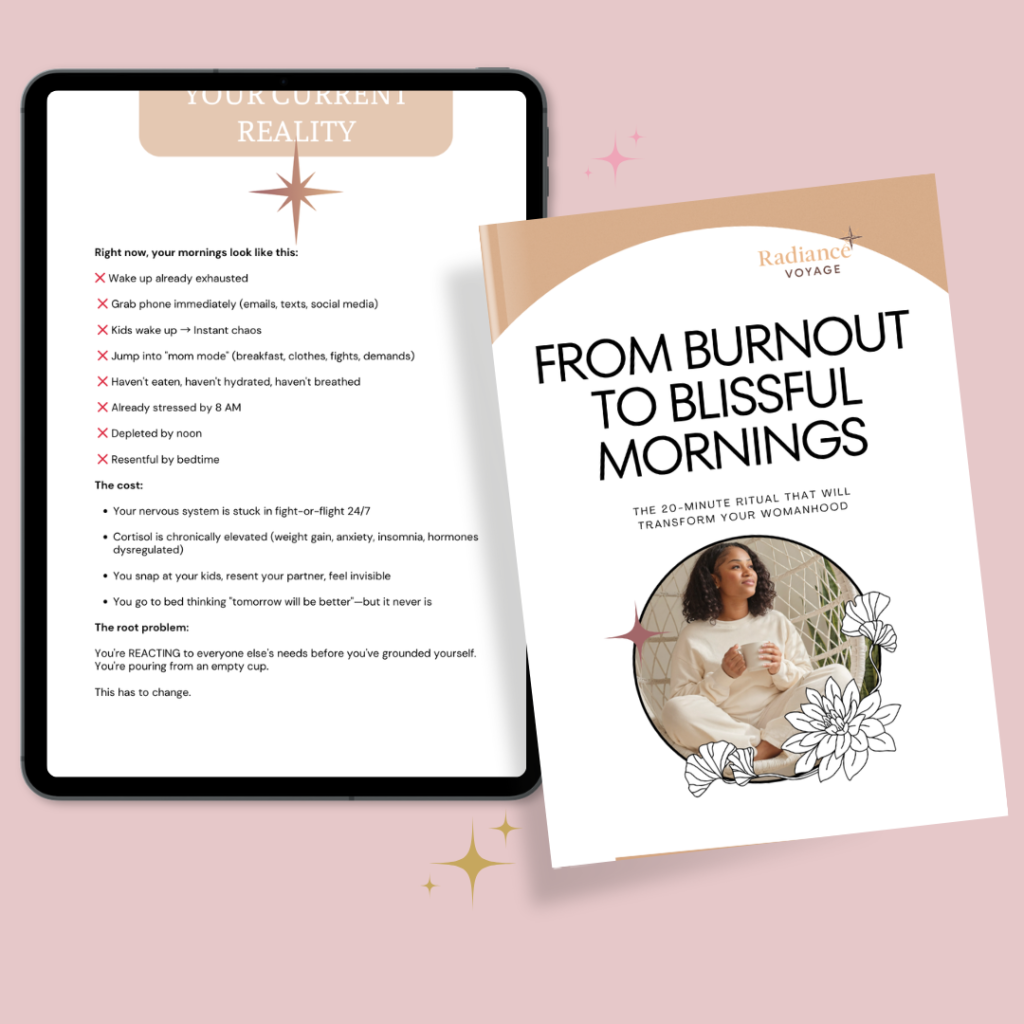
If that’s something you’ve been needing, I created something simple for you.
From Burnout to Blissful Mornings
This is a gentle reset you can return to, especially on the days when everything feels like too much before it even starts.
Inside, you’ll have a simple way to:
- Start your mornings feeling calm instead of rushed
- Create small moments of stillness before the day begins
- Reconnect with yourself before you begin giving to everything else
- Set the tone for a day that feels more grounded and less overwhelming
This is not about adding more to your routine. It is about creating space within it.
You can download it here:
👉🏽 From Burnout to Blissful Mornings
How This Connects to Everything You Just Read
The way you start your day quietly shapes how you show up in it.
When you begin your morning already overwhelmed, it becomes much harder to pause, to check in with yourself, and to honor your boundaries throughout the day.
But when you begin from a place of calm, even just a little, you create more space to:
- Notice what you feel
- Respond instead of react
- Stay connected to yourself in moments where you would usually override yourself
It does not change everything overnight, but it changes how you move through everything.
Conclusion
You do not need to become harder, colder, or distant in order to have boundaries. You can remain soft, kind, and open, while also being clear and grounded in what works for you.
Over time, this becomes less about effort and more about awareness. You begin to move through your life in a way where you are present with others, while still staying connected to yourself.
And that is where things begin to feel different.
Not forced.
Not something you have to constantly think about.
But a steady way of being, where you are living your life without leaving yourself behind.